

Cantilever scaffold design usually comes up when a standard ground-supported scaffold no longer solves the access problem safely. Often paired with suspended scaffolding, it can be incredibly useful for situations where ground work is difficult. For example, if your work face sits above a lower roof or canopy, or if the structure itself creates support limitations, these factors will make a typical base-supported layout impractical.
That’s where the conversation changes from “What scaffold can we rent?” to “What does this system need to do, and how will it safely transfer load?” A cantilever scaffold can be an effective solution, but you’ll need a professional scaffold engineer to ensure it meets all necessary support conditions, anchorage, stability, and field tolerances.
For contractors, suppliers, and project managers, the key question isn’t whether cantilever scaffolds exist as an option. It’s whether your project conditions have moved into the non-standard design zone where expert engineering input is needed before work can begin.
Does your project already show signs of restricted support, unusual loading, or difficult tie-in conditions? You’ll need a professional company like Scaffold Engineering Inc. to explain what a cantilever scaffold is, when engineered design is required, what our engineers review, and what information helps the design process move faster.
What is a cantilever scaffold?
A cantilever scaffold is a scaffold platform supported by structural members that project outward from a building or other support rather than bearing directly on the ground below.
In practical terms, the scaffold doesn’t rely on a straightforward vertical load path down through frames or legs into a base on grade. Instead, the system depends on other supporting structure conditions to carry the platform and its loads safely.
What is a cantilever scaffold used for?
A cantilever scaffold is used when crews need access at a location where the scaffold cannot be supported directly from the ground below. That often includes obstructed areas, lower roofs, active entrances, or building conditions that make a standard base-supported scaffold impractical.
How a cantilever scaffold works
Cantilever scaffolds work by supporting the platform from projecting structural members, rather than from a direct base below. Instead of carrying load straight down into the ground, the scaffold transfers load back into the building, or another adequate support structure through engineered support points.
In simple terms, the load path works like this:
- Workers, tools, and materials place load on the platform.
- That load transfers into the cantilevered support members, brackets, needles, or other projecting elements supporting the scaffold.
- Those members then transfer force into anchors, tie-ins, or structural attachment points.
- From there, the existing structure must safely resist those reactions without overstress, excessive movement, or instability.
This is what makes a cantilever scaffold different from a standard supported scaffold. A standard supported scaffold usually relies on a more direct and visible path into the base below. A cantilever scaffold depends on engineered support conditions that are less forgiving of bad assumptions, inaccurate dimensions, or unverified attachment points.
The entire setup often becomes more sensitive to exact dimensions, stiffness, tie locations, and erection accuracy. That delicacy is why consulting a structural engineer is key.
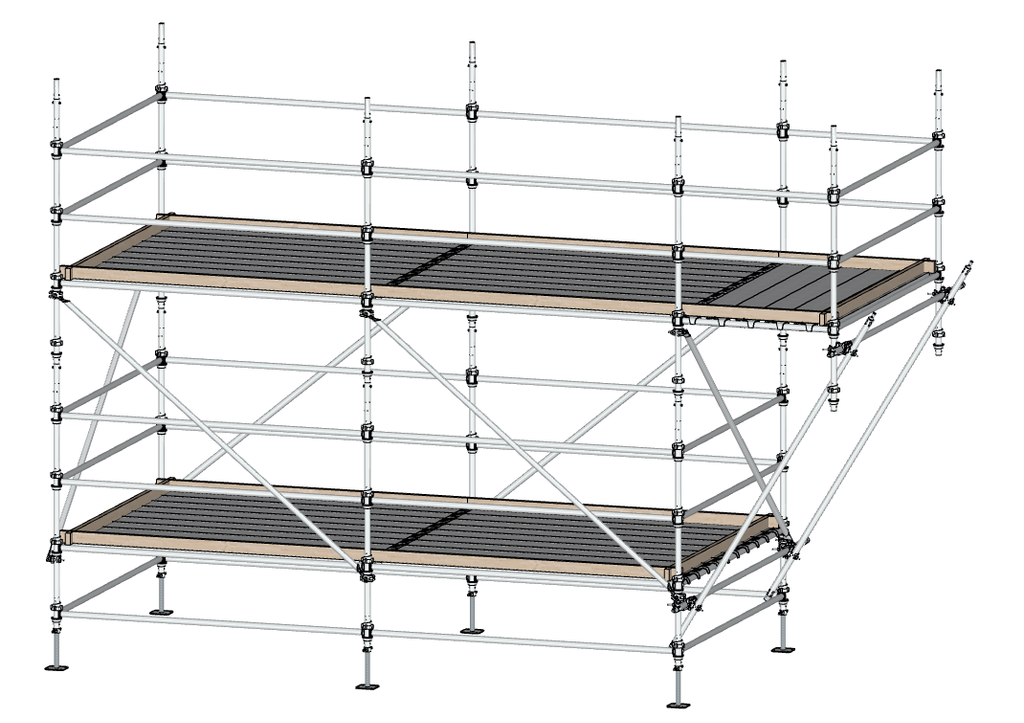
Cantilever Scaffold Design Solutions
Cantilever scaffold design is usually required when a standard supported scaffold no longer matches the jobsite reality. Obstructions below, limited support conditions, unusual geometry, and difficult tie-in requirements all push the project into a category where engineered review matters.
That means the scaffold needs to be designed around the actual field conditions, the real load path, and the way crews will use it. On commercial and industrial projects, that practical engineering work is what turns a difficult access problem into a buildable plan.
If your project is moving beyond a standard scaffold layout, check out our scaffold design services and contact us today for engineering support that is practical, code-conscious, and built for the field.
FAQs
What information does an engineer need to design a cantilever scaffold?
An engineer typically needs site dimensions, elevations, existing structure details, intended platform loads, work scope, access requirements, and any sequencing or clearance constraints that affect the design.
Why is a cantilever scaffold riskier than a standard supported scaffold?
A cantilever scaffold can carry more risk because its support path is less direct, it depends more heavily on existing structure conditions, and it usually has less tolerance for inaccurate assumptions or erection deviations. If the support is incorrectly calculated, the scaffold may collapse or cause injuries in the workplace.
